Showing posts with label pump. Show all posts

Pump plumbing Topping Up and Kiddie Covers

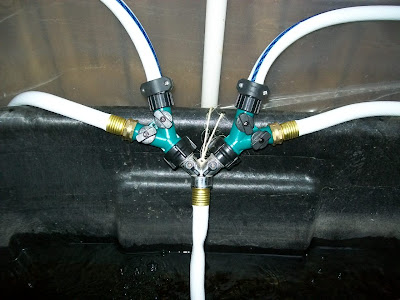
Using garden hose to carry water from the sump


I was stymied about how I was going to carry the water from my 1000 gph pump back to my four growbeds. Id looked into 1" no-kink pond tubing and associated fittings/valves, but the tally was getting pretty pricey.

When I was first plumbing the 1000 gph pump in for just 2 growbeds, I figured garden hose might work - and if I was wrong, I would only be out the price of a single length of hose and a single splitter (with built-in ball valves). Garden hose ended up working fine for just two growbeds.

I still wasnt sure garden hose would work for the full-up system, particularly with the long (23) lengths needed to reach each of the two growbeds on the opposite side of the greenhouse from the sump. But I was willing to try. Turns out garden hose works like a charm. I even have to throttle the flow just a tad.

Youll want to get hose that is safe to use for drinking water, because regular hose can leach lead into the water. This set-up requires 60 feet of hose, so you could either get a single 75-foot hose (~$40 via Home Depot, search "lead-free hose") or two 50-foot hoses (~$23 each via Home Depot, search "neverkink boat hose"). You can get free shipping if your total order is over $50, assuming your local store doesnt have these hoses in stock.

Auto Top Up - Think Water Cooler


In watching Murray Hallams "Aquaponics: The First 12 Months," I saw his contraption for automatically adding water when the tank gets low - like the ballcock older toilets use to shut off flow into the bowl when its full of water after a flush. He had his hooked to the home-owners water spigot. My only trouble was I couldnt find the exact configuration at my local hardware store, and googling ballcock with my computers kid-friendly browser settings made finding anything online even harder.

Since I currently have goldfish in the sump, and plan to use the sump for small fish, I dont want my sump to run dry. Even if I couldnt find the exact contraption Murray uses.

I came up with the idea of a water reservoir, like a water cooler. I use the standard 5-gallon bottles to do this. I cut the neck off the bottom bottle and drilled 1" holes into the sides to allow tank water in.

Next I add 1/2 teaspoon of Amquel to an empty 5-gallon bottle, then fill with tap water. The Amquel removes chlorine and other nasty stuff from the tap water.

Finally I invert the regular 5-gallon bottle and rest it in the top in the modified bottle.

As the water in the system evaporates, the water in the 5-gallon reservoir glugs out, bit by bit. I anticipate this will make adding water a weekly chore and eliminate risk that my sump runs dry without me noticing.

Construction of a Kiddie Cover


I dont have kids that could/would drown in 20" of water, but Kiddie Covers make the fish happier. Bluegill, at least, dont like to be without cover (fear of predators that might scoop them out). Plus bluegill are known for jumping out of the tank (lost one myself that way).

I just used cheap 1x3 for the covers, supported by frames made of inexpensive 2x3. This picture showed in this post has a close up of the more complicated sump tank lide, which has a cut-out for the 5-gallon reservoir.

Finally, below is a link to some video footage I shot today. The first video is really long (over 12 minutes) showing how the kiddie covers work, feeding fish, how the CHOP plumbing works, the final bell siphon design, and the top-up tank.

The second video is 3 minutes long and explains how I plumb the water to the growbeds on the opposite side of the greenhose (and talks about my solar oven).


Read More..

Intermitent Pump Systems


  My goal with these designs is to save energy by running a pump intermittently rather than 24/7 using an ebb&flow design, but the problem with ebb&flow is the regurgitation of solid fish waste and uneaten food.

  I think these ideas would only be worth while if the system were small.  With a large system the cost of circulating 24/7 would be applied to a much larger grow bed array.   But for a small system where pennies count and the harvest is small, I think there are ways to make an ebb&flow work.  Here are a couple ideas Ive had.

   I have drawn this system that would use the ebb & flow method and return clean water to the fish tank.  Water would be held in the settling/filter tank while the pump is on.  Then the clean water would return to the fish tank when the pump is off.
   An overflow would allow excess water to flow back to the fish tank. 
While the pump is filling the settling tank a solenoid valve would hold the water in the grow beds and settling tank.  A timer would turn the pump and the normally open solenoid valve off allowing the grow beds and settling tank to drain back to the fish tank.
   This design is an improvement over the classic ebb&flow design because the settling tank allows for the water to be cleaned before returning to the fish tank.


Here is another concept drawing which uses vertical gardening and a reservoir/settling tank.  The water is pumped to the reservoir with an intermittent timer.  An overflow tube would return excess water to the fish tank.
Filtered drip lines from the reservoir would supply a constant water flow to the vertical tubes.  If made of fiberglass reenforced weed cloth the water would be returned to the fish tank with plenty of aeration.


With proper filtration around the pump the system could be set up as simple as this. 
The pump would be on a timer.  The vertical media does not require constant flow.

UPDATE 12/23/2012
The ebb&flow design above is a bit complicated.  A design that has been working for two months can be seen at [The Perfect System]


Read More..

Choosing a Pump

The first consideration is external or submersible.  The reasons you may wish to go with an external pump is power consumption and GPH.  Submersibles are easier to install, and generally less expensive, but the most efficient pumps are external. Some pumps can be run as either external inline or submersible.

This is not to say all external pumps are efficient. Many are power gluttons so be sure to check    
Some pumps actually consume less than the rated value.  Perhaps they rate their pumps at maximum power dissipation before failure.  We can only go by the number they specify unless you have access to the pump and make your own measurements.
For example a Max-Flo 960 GPH for $106 will be less expensive at the end of the year compared to an ActiveAqua 1000 GPH for $57.00.
They both pump about the same GPH, but the Max-Flo uses 35 Watts less energy.
That will save you 25 KWH per month if run 24/7.

External pumps generally move more water.   My experience has shown that waterfalls need at least 2500 to 3000 GPH.   Aquaponic systems generally require a pump that match the size of the fish tank.  Ive read 2-1/2 times the size of the tank with head loss is about right.  That ratio is probably negotiable.

Head pressure is the height the pump stops pumping water.  Some pumps are designed to move water efficiently with little change in height.  Others are designed to lift water.  You will have to find a pump that fulfills your needs without loosing too much efficiency to lift.  In the comparisons below my calculations for Gallons / Watt are based on zero lift.  Your final decision should be calculated with your required lift in mind.  You will have to consult the head loss specifications which are generally provided. 

If you choose to use a submersible you should be aware that some are filled with transformer oil.  Hardly something you would want to leak into your fish tank or pond.  Ive had it happen twice so make certain it says No Oil.  Oil is used to offset the water pressure, and keep it out of the motor compartment.  But there are better ways to deal with this.

Epoxy filled pumps encase the motor winding in epoxy.   The permanent magnet which drives the impeller is allowed to sit in the water.  Epoxy filled pumps are in my opinion the best way to go if you are buying a submersible pump.  Oil filled are OK as a utility pump such as pumping out a flooded basement.

The impeller is often driven by way of a V-notched disk which allows it to slip if it becomes stuck, but the V-notch often becomes worn, and then impeller fails to pump any water at all.  So I try to avoid pumps that use this cheap V-notch clutch.   Other  methods use magnetically connected impellers or direct drive impellers.

Continuous duty operation is important to both a pond or aquaponic system.  The most vulnerable parts are the impeller and the bearings.  Some pumps are designed to allow these parts to be replaced.  Others are designed to be thrown away or the parts are so expensive it becomes a throw away.

Quiet operation is a consideration.  As the bearings wear any external pump will become louder, but its nice to start out quiet, and when you begin to hear the pump its time to think about repairs or replacement as it will not be long before it fails. 


Some of the more efficient pumps are listed below.
Submersible pumps in the  700 - 3100  GPH range
External        pumps in the 2400 - 4000 GPH range.

External Inline Pumps
Dolphin 115V Amp Master Series Pump
3900 GPH
161 Watts (24.2 G/W)
 $392.06
ReeFlo 2500/4300 External Pump with Saltwater Seals
2500 or 4300 GPH
105 Watts  (23.8 G/W)
or
4300 GPH
175 Watts  (24.6 G/W)
$299.00
AZFlo 2400/4000 External Pump by ReeFlo
2400 or 4000 GPH
105 Watts  (22.9 G/W)
or
4000 GPH
175 Watts  (22.9 G/W)
$309.00
PondMaster Supreme Inline/Direct Drive HyDrive Skimmer Pond Pump
Saltwater OK
3200 GPH
200 Watts  (16.0 G/W)
$217.82
Pondmaster Magnetic Drive Waterfall/Skimmer Pond Pump
2000 GPH
150 Watts  (13.3 G/W)
$139.00
Alpine Waterfall Hurricane Pond Pump
3100 GPH
175 Watts  (17.7 G/W)
$139.99
CalPump Waterfall Pond Pump
3500 GPH
205 Watts  (17.1 G/W)
$149.00

For many years I  have used a
Sequence 750 Pump 3600SEQ12 -3600 GPH
They seem to last about 3 years which is when the warranty runs out.
3600 GPH at zero head and 2400 at six feet.
They consume 139 Watts  ( 25.9 G/W)
and cost $289.00
 

Submersible Pumps
Laguna Fountain And Statuary Water Pond Pump
750 GPH
112 Watts  (6.7 G/W)
$90.00
Pondmaster Mag Drive Pond Pump
700 GPH
60 Watts  (11.7 G/W)
$94.99
Pondmaster Mag Drive Pond Pump
950 GPH
93 Watts  (10.2 G/W)
$109.99
Alpine Hurricane Pump
3100 GPH
175 Watts (17.7 G/W)
120.00

All but the Alpine Hurricane pump are available at AZ Ponds
I have bought many pumps from AZ Ponds and like doing business with them.
I used to like doing business with them. This last time they failed to send a tracking number.  After I called they said they would call back and never have.  They are on my shit list.

I also have a submersible Alpine Hurricane Pump 2400GPH
2400 GPH at zero head and 1751 at six feet.
The specs show that it consumes 157 Watts  (15.3 G/W),
but my measurements show that it uses only 128 Watts for (18.8 G/W)
It costs $129.00, but I found  on sale for $58.00!
This is a really nice Oil-Free, Magnetic-driven, Epoxy Protected, Ceramic Shaft & Impeller pump with a three year warranty.

Here is another excellent article about pumps.
Read More..

Good Air Pump

UPDATE: 

I found this air pump that seems to be exactly what most of us would want.
The AP 100 is quiet at 45db.
It pumps 144 liters per minute at zero head pressure
And the pressure is outstanding - 181 inches of water, but they conservatively claim 11 feet! 
100 Watts is not bad either.
It even comes with a rebuild kit!

______________________________________________________________________

This General Hydroponics air pump is Extremely Quiet has a lot of pressure (84" of water) which is required for many air lift situations. 20 liters per minute is not earth shaking but its enough to air lift the water for my Earthan Beds. 

The quiet operation and psi of this little $69.00 pump really impress me.  General Hydroponics does not state in db how much noise is made, but I think it could be placed next to a living room aquarium.  The sound of the bubbles would probably be louder than the pump.

http://www.1000bulbs.com/product/95293/GROW-GH2716.html?utm_source=SmartFeedGoogleBase&utm_medium=Shopping&utm_term=GROW-GH2716&utm_content=Air+Pumps&utm_campaign=SmartFeedGoogleBaseShopping&gclid=CN7G2qO-8rsCFcVQ7AodEVIALw


General Hydroponics GH2716 - Dual Diaphragm Air Pump
www.1000bulbs.com
Shop for General hydroponics GH2716 Dual Diaphragm air pumps. Four outlets pumping 20 liters per minute. Low prices on air pumps at 1000Bulbs.com.

Another good air pump is the Hakko.  Here are the specs of the six modles they build.
Hakko25 - 21 liters per minute, 17w, 3.7 psi (32dB)
Hakko40 - 51 liters per minute, 40w, 5.5 psi (35dB)
Hakko60 - 68 liters per minute, 63w 6.7 psi (38dB)
Hakko80 - 86 liters per minute, 85w, 7.8 psi (38 dB)
Hakko100 - 105 liters per minute,116w, 6.5 psi (40dB)
Hakko120 - 121 liters per minute,126w, 7.8 psi (42dB

For large air I have used the Active Aqua 70 lpm and the Eco-Plus 7 with 200 lpm.  Both of these are very loud.  My Active Aqua 70 lpm destroyed itself in less than a year.  The Eco-Plus 7 has been in continuous use for about a year and it runs much cooler due to the larger fin size.  Eco-Plus 7 is the better pump in my opinion.   Mine uses 60 to 90 Watts even though its rated at 200W.  It also will pump to a depth of 84".

I have no experience with the Elemental O2 Commercial Air Pumps but the
571 gph/43 lpm delivers 2.47psi
951 gph/72 lpm delivers 3.48 psi from 41watts
1157 gph/87.6 lpm delivers 4.64psi


1 pound per square inch = 27.6704523 inches of water. 

Read More..