Showing posts with label Aqua. Show all posts

Pump plumbing Topping Up and Kiddie Covers

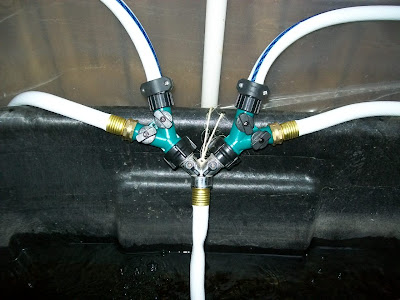
Using garden hose to carry water from the sump


I was stymied about how I was going to carry the water from my 1000 gph pump back to my four growbeds. Id looked into 1" no-kink pond tubing and associated fittings/valves, but the tally was getting pretty pricey.

When I was first plumbing the 1000 gph pump in for just 2 growbeds, I figured garden hose might work - and if I was wrong, I would only be out the price of a single length of hose and a single splitter (with built-in ball valves). Garden hose ended up working fine for just two growbeds.

I still wasnt sure garden hose would work for the full-up system, particularly with the long (23) lengths needed to reach each of the two growbeds on the opposite side of the greenhouse from the sump. But I was willing to try. Turns out garden hose works like a charm. I even have to throttle the flow just a tad.

Youll want to get hose that is safe to use for drinking water, because regular hose can leach lead into the water. This set-up requires 60 feet of hose, so you could either get a single 75-foot hose (~$40 via Home Depot, search "lead-free hose") or two 50-foot hoses (~$23 each via Home Depot, search "neverkink boat hose"). You can get free shipping if your total order is over $50, assuming your local store doesnt have these hoses in stock.

Auto Top Up - Think Water Cooler


In watching Murray Hallams "Aquaponics: The First 12 Months," I saw his contraption for automatically adding water when the tank gets low - like the ballcock older toilets use to shut off flow into the bowl when its full of water after a flush. He had his hooked to the home-owners water spigot. My only trouble was I couldnt find the exact configuration at my local hardware store, and googling ballcock with my computers kid-friendly browser settings made finding anything online even harder.

Since I currently have goldfish in the sump, and plan to use the sump for small fish, I dont want my sump to run dry. Even if I couldnt find the exact contraption Murray uses.

I came up with the idea of a water reservoir, like a water cooler. I use the standard 5-gallon bottles to do this. I cut the neck off the bottom bottle and drilled 1" holes into the sides to allow tank water in.

Next I add 1/2 teaspoon of Amquel to an empty 5-gallon bottle, then fill with tap water. The Amquel removes chlorine and other nasty stuff from the tap water.

Finally I invert the regular 5-gallon bottle and rest it in the top in the modified bottle.

As the water in the system evaporates, the water in the 5-gallon reservoir glugs out, bit by bit. I anticipate this will make adding water a weekly chore and eliminate risk that my sump runs dry without me noticing.

Construction of a Kiddie Cover


I dont have kids that could/would drown in 20" of water, but Kiddie Covers make the fish happier. Bluegill, at least, dont like to be without cover (fear of predators that might scoop them out). Plus bluegill are known for jumping out of the tank (lost one myself that way).

I just used cheap 1x3 for the covers, supported by frames made of inexpensive 2x3. This picture showed in this post has a close up of the more complicated sump tank lide, which has a cut-out for the 5-gallon reservoir.

Finally, below is a link to some video footage I shot today. The first video is really long (over 12 minutes) showing how the kiddie covers work, feeding fish, how the CHOP plumbing works, the final bell siphon design, and the top-up tank.

The second video is 3 minutes long and explains how I plumb the water to the growbeds on the opposite side of the greenhose (and talks about my solar oven).


Read More..

Shake Rattle Roll

USGS Map of Tuesdays Virginia Earthquake


We had an earthquake Tuesday, and I missed it, because I was driving on the interstate. The rumbling sensation of a large truck passing by isnt as remarkable when youre on bridges with large trucks passing by...

Turns out earthquakes on the east coast of the US can be "worse" than a same-magnitude quake on the west coast.

Though the west coast of the United States experiences significantly higher seismic activity, the crust in the eastern United States is more efficient at propagating seismic waves because its older and colder. For example, a magnitude 5 in San Jose, CA would be moderately felt 45 miles away in San Francisco. In contrast, an east coast magnitude 5 (or 5.9 in our case today) could be felt for several hundred miles. The earths crust in the east coast propagates much more energy at high frequencies than crust in the west coast, so small structures like homes experience about a factor of 5 more shaking. [Derived from a post by kmayeda at OpenHazards.com]

Luckily, my old-construction masonry home isnt showing any cracks. Phew!

I did take the chance to snap a few pics of my (overgrown and un-tended) garden. Enjoy!


Goldfish in my Sump
Read More..

Aquaponics Yabbies!

I just raised some baby yabbies. Yabbies are a freshwater crayfish that call Australia home.

Which is nice.

So now I have to farm them.

Tricky.

Yabbies are so delicious that they tend to eat each other.

Yum!

Tricky.

The problem is they they each want a stack of space to call their own.

They also take their time growing, but I just found this from...

http://www.fish.wa.gov.au/Documents/aquaculture_yabbies/how_to_grow_bigger_yabbies.pdf

"Separating males and females by hand is time-consuming and prone to mistakes. To make this
easier and more accurate, a hybrid has been discovered that only produces male progeny (by
crossing male WA yabbies Cherax albidus with female Cherax rotundus yabbies from NSW)"

According to the Western Australian Government fishy people, "Monosex culture provides a 70 per cent increase in gross return to the farmer."

Ive had my first batch of yabbies drop from their mother, so Im now a little obsessed with high stocking rates. I have the entire clutch in a very small 30 litre tank. So far they dont seem to be hurting each other, but they are very vulnerable when they shed their crunchy outer shell to make room for the next bit of growing they plan on doing. Shedding your armour also turns your pincers into mushy things that are no good for pincing.

No good at all.

I put the berried (thats what we yabby farmers call yabbies with eggs stuck to their undersides) female in a cage made of gutter guard (a plastic mesh to keep leaves out of your houses gutters) so the delicious babies would fall through and wouldnt get eaten by their mum. It seemed to work. Babies would let go, spend a minute or so near their mother, then drop to the bottom and never return.

For high density raising, I have a bit of a moral problem with battery hen style conditions even though (or perhaps because) I did some work on a design a few years back. But now I have an idea that I think might work for an IBC.

Basically its a 3D zig-zag of shade cloth that works its way down a container like a staircase...kind of, so that there is a minimum of 5cm and a maximum of 8cm between each level. Ill attach a stack of PVC homes on each level that get larger and fewer as they get to the top. All of them should point downhill a bit so food and waste dont get stuck, and the basic plan is that the bigger you are, the higher you rise in the yabby high-rise (with me being at the very top). There would be gaps around the edges, so the smaller yabbies and babies would be able to find their way down with ease. They can sort it out among themselves as to who gets the housing at the top nearest the biggest food.

Watching my adult yabbies, I see that when they eat they let a lot drop. They leave a lot of crumbs. They make Cookie Monster look like something best described with words like "refined". They are also bottom feeders, and are not opposed to eating a meal that has already made its way through somebody elses digestive tract. Or more than one somebodys digestive tract.

So my hope is that I can add fish feed, or even veggie scraps (yabbies arent fussy) into the top, and draw nutrient rich waste water that has been munched into very fine particles from the bottom to add to my growbed.


120 Things in 20 years needs to learn stuff. Its been a while.
Read More..

Final Greenhouse Design


Construction starts today, so I thought Id share the final design Im going with.

Because I am constrained to have the structure less than 52" above my patio, Ill be digging a sunken aisle down the middle of the greenhouse, between the growbeds. I had wanted to have a 300 gallon fish tank, but Im willing to settle for a 150 gallon (600 liter) stock tank for the fish with a 100 gallon (400 liter) stock tank for the sump. The smaller tank will allow me to have an aisle through the entire greenhouse, which should be simpler than having the center blocked by the tank. The plan is to raise blue gills and redears, with a catfish or two.

The little green circles are planned vertical towers I will be making out of 4" PVC sewer/drain pipe - you can buy these at Aquaponicsource. Im going to try my hand at making them myself, since I think Ill break even making 6 of them.

The large green oblongs are the 50 gallon rubbermaid stock tanks. The two overlapping the fish tank will just drain into the fish tank. The fish tank will have a drain near the top that will be plumbed to drain into the sump. The vertical towers and the two grow beds overlapping the sump will all drain directly into the sump. So this will be a hybrid CHOP/CHOP-2 design.

Today Ill probably wont get more than the foundation in, but the die is cast...
Read More..

Ancient Aquaponics

TombofNeb-Amun01

Aquaponics - the symbiotic cultivation of fish and edible plants, has been around for over 6000 years. It is seen (above) in the fabulous paintings from the tomb of Nebamun, and a drawing in King Tuts tomb shows the boy king merrily flipping two tilapia from an aquaponic pond into the arms of his wife.

Since I like food and technology and saving the planet, aquaponics is a natural for me. Ive been checking out the burgeoning aquaponics movement in Australia, and decided to create a system of my own here in the US.

Ive come across four options:

1) Buy the stylish "Farm in a Box" from EarthSolutions ($3000 + S&H on Amazon.com for the 200 gallon version).

2) Buy the lovely "Aquabundance" system from theaquaponicsource.com ($1295, free shipping, 60 gallon unit)

3) Buy one of the aquaponicsusa.com "Food Forever Growing Systems" ($895 + S&H for the 100 gallon bare bones system).

4) DIY from IBC containers, 55 gallon barrels, bathtubs, etc.

Underwhelming compared to the cool stuff theyre doing in Australia.

So why isnt aquaponics taking off in the US? You know, because if it were popular in the US, I could find supplies and get a system without paying four digits...

Ive decided its because it gets cold here in the US.

Look at a map - Australia is mostly within 30 degrees of the equator, kind of like Central America. It pretty much just doesnt get cold there. Sydney, Australia, is as far south of the equator as Los Angeles, California, is north. Think warm/hot, frost-free weather year round.

No wonder the Aussies can do aquaponics in their backyards! For those with a greenhouse or a large porch in the warm climes of the US, the Farm in a Box or Food Forever Growing Systems make a lot of sense.

The Aquabundance system takes the cooler US reality into account - the system is small enough to fit through doorways and has a cart with wheels for the growbed. But to equal the recommended 1000 liter system most Aussies talk about (250 gallons), Id have to get at least 4 Aquabundance units - over $5000.

I wish I had $5000. But I dont. So Im going to try to figure out how to do a system that looks good that doesnt cost lots of dough.
Read More..

Stirling engines Ball bearings

From what Ive read, shiny wire does a better job of being a bearing on a tin can Stirling engine, but I want to see just how much extra friction a proper ball bearing race or two would add to the mix.

The friction levels are very low on these little engines.

They have to be or they just dont work.

But I want to try to make a more robust version, and perhaps even make one that is capable of doing some work.

Perhaps.

But probably not.

Any attempt to make a bigger tin can Stirling engine would also involve a lot more weight. And more weight means more wear and friction. Ball bearings will be the solution, as long as there is enough power left over to overcome the extra friction that bearings have.

That sounds a little contradictory, but bearings are really good at dealing with extra load on the rotating surfaces, but they involve a little extra friction than say... hovering in space.

So, with this in mind, I looked into small bearings.

They cost a lot.

A 12mm (internal) ball bearing race is a very standard thing that industry makes. They cost around $2 each retail, and are a weighty, very strong thing you might find in a motor bike, or in the centre of a bicycle wheel. They carry a lot of weight, and last for ever. But they have way too much friction.

The little bearings I want that are only around 1.5mm in diameter (internal) all seem to cost around $20 each. They are nothing like the robust 12mm ball bearing races I looked at.

Tiny.

Fragile. (actually not really, but compared to the 12mm version...)

Fragile.

And expensive.

But my fishing real has a dozen of the things. They cant really cost that much. It must just be that there is no real retail trade in them. I need three or four, so I thought of buying a $20 K-mart fishing reel, and pulling it to bits, and thats probably what Ill end up doing. But in the mean time, I really want to know if a bearing will be too costly in terms of friction.

I found a little computer cooling fan in my electronics junk drawer. I figured that should have at least one bearing.

These little fans dont put a lot of stress on their little bearings, but they last for ever and spin really fast, with little friction.

Last for ever, fast.

Perfect.

I started by removing all the bits that didnt look like a bearing.

How hard could it be.

Very, it turns out.

Thats the little bearing inside the small brass tube.


I spent a lot of time and energy trying to get it out.

I started by trying to knock out the pin by gently placing a centre punch (made of thick wire) on the centre axle, and smacking it with a hammer as hard as I could.

That didnt work so well.

Actually that didnt work at all.

I finally got it to give some ground by taking a hacksaw to it, and cutting through all the hard plastic surrounds that held the coils to the little motor.


This left me with a much more manageable bit of kit, that even looked like it might finally surrender its bearings.

In fact, this would be perfect if I could just get the pin out of the centre, so I could put the Stirling engines wire crank through the centre.

Centre.

Difficult
I put one end in over the opening of a little socket so the punch could get through and hit it hard.

Nothing happened, so I turned it over and hit it again.

Thats my trusty hammer at the top of the frame.

Camera shy hammer.


This time it worked.

Theres a little flange on one end of the pin that was making it impossible to tap out.

An amazingly strong little flange.

I hit it hard.

A lot.


Now that the shaft was out, I needed to knock out the bearings. I tried inverting the socket so its outside fit inside the brass sleeve, and rested against the bearing. I hit it again.

And again.

And some more.

In the end I just kept cutting.

The hacksaw was the only thing making any progress.

Who would think there would be a time where a hammer failed me.

Theres no real danger of damaging the little bearings here, as the brass sleeve is soft and bearings are made of insanely tough... stuff.

The bearings came out with ease, once the brass was cut through.

It turns out that the brass sleeve is really a brass sleeve with a divider in the middle.

No amount of hammering was ever going to get the bearings out.


Oddly, after all that hammering, the bearings still roll reasonably.

Reasonably.

The reason the little fan was part of my electronics junk drawer in the first place, was because it no longer turned. I think it was the cooling fan that I replaced on my rectifier, so it was never going to work perfectly.

The bearings spun freely enough after rotating them for a while with my drill. but there was a little bump in each revolution.

This pic is of the new ball bearing raced tin can Stirling engine running on my stove-top at around 200rpm.


200rpm is around the same speed on the same heat setting as it ran before, but it no longer runs from the heat of a single candle at only 36rpm, so the bearings have increased friction a little.

The brass sleeve was replaced with a cable tie for each bearing, and it turns out that cable ties fit nicely into my adjustable screw in bearing mounts.

Having the adjustable wire crankshaft I made turned out to be worthwhile, as I would never have been able to make just this one change. The smallest change in the crank shaft, in either the displacer crank, or the power piston crank makes a lot of difference as to how well my little Stirling engine runs, so it would be very hard to tell if it didnt work because of the bearings, or because of the different crank I would have been forced to make.

So.

A success as far as this little engine up goes. The bearings are small, but should be more reliable than the a plain wire on wire bearing. And it seems the friction loss is only around a quarter of a candle.

An interesting addition to this learning thing.


120 Things in 20 years measures the amount of friction in a tin can Stirling engine in "candles". I think I just invented a new metric.
Read More..

Entomology A bee!

All last summer there were no bees, and I had to polinate everything by hand.

The closest thing to a bee in the last year Ive seen, was a dead one at my mums house 10 minutes drive away from my house.

No bees.

They are all dying out everywhere on the planet.

Colony collapse disorder I think its called.

But I saw one, alive and kicking in my backyard today.

After chasing it around for half an hour as it frantically tried to escape my shade cloth I finally got a pic of it.

Thanks rapid fire camera maker.

Tis a poor pic, but it does prove a bee still lives.


120 Things in 20 years - Entomology - Yay BEE!
Read More..

Aquaponics Tomato

Its cold and rainy here in South Australia, and I keep picking tomatoes.

Winter isnt a good time for tomatoes, but mine seem to be having fun anyway.

My four tomato plants that are growing so their roots are suspended in the fishtank water seem to be fruiting a lot later in the season than they should be. The plants are out in the cold, but their roots are inside the fishtank which is inside a little growhouse.

The plants look like this.


And they are still doing a lot of flowering.


And there are plenty of fruit all over the vines.


And the fruit are still ripening.

These were todays pickings.

Not many today, but there are always some. And a few didnt make it inside.

And there are a lot more on the vines that are nearly ripe. Ripe enough to eat.


All these pics were taken today. Its winter in the southern hemisphere, so the tomatoes should have stopped fruiting a while ago.

Its strange that they are still growing and fruiting this late. Strange enough that I thought Id contact someone from one of our universities. I remember someone from my research into bees, who was working on growing native bees to pollinate tomatoes. Im not sure if there were a bee person or a tomato person, but I emailed them in the hope that if they dont care, they might know someone who does.

It might save the industry a bit of money if it turned out the entire plant didnt need to be kept warm to keep them fruiting.


120 Things in 20 years says to be on the lookout for tiny hot houses with tomatoes growing out of PVC tubes, coming to a winter tomato farm near you. Or not.
Read More..

Thinking Multiverse

So, apparently we live in one small manifestation of the universe within something called the Multiverse. This is according to some apparently excellent equations.

I dont like it.

One version of the Multiverse says that every possible version of the universe exists, and theres some stuff about a new universe popping into existence every time a decision is made. And a stack of other stuff as well.

As far as I can see, the main upshot of all this, is that people tend to talk about it a lot. Im not so sure it makes any useful predictions or anything, but that doesnt mean it isnt true.

As I understand it, I think its more of an inevitable side effect of some awesome equations rather than something people really want.

I know I dont want it.

Ive never been comfortable with the concept because it seems a little wasteful. Just think of how much energy is required to support a universe made entirely of blue paint with nothing (obviously) that needs painting. Painting blue paint blue is a foolish errand in anyones book.

See my problem.

But this morning I found a yellow sticky note on my screen in my handwriting that said...


"This version of the universe just so happens to be one where the Multiverse doesnt exist."


Problem solved.


120 Things in 20 years has only had five hours sleep in the last three days, but I dont think anyone can tell.


Read More..

Rocket Mass Stove

Ive mentioned this before, but this is such a neat way to heat that I wanted to make an entry just for Rocket Mass Stoves and include the best videos and links I have found.  

Paul Wheaton from Permies.com demonstrates in this first 2 minute video just how efficient the Rocket Mass Stove is.  You see this video frame here where this lady has her face over the flue pipe.  The heat and fumes from the flue are warm not hot and very clean.  I hope you will explore the videos at  Permies.com.  It is one of my favorite sites!


Efficiency is the key to heating a green house.

This simple low tech stove with exceptionally high efficiency is something anybody could build.
Why do we continue the spend thousands on air tight stoves that pollute and burn more wood?


http://tinygreenlove.blogspot.com/2012/02/amazing-rocket-mass-heater.html


Below is another favorite video educator.  Rob Torcellini shows the details of how he built a Rocket Mass Stove to heat his greenhouse.  The same stove could heat your house.

Add a self feed bin for pellets!  This is how Rob did it.

Rob has taken the Rocket Mass Stove to a very sophisticated level. His excellent engineering skills and preparations while building his green house have payed off well.

Hear are some more ideas


Ive included this video because it demonstrates the effectiveness of a rocket mass stove


Read More..

Aquaponics Venturi adjustment

I thought Id make a little adjustment to my venturi as suggested by Mike Creuzer in a comment on this post on my Venturi air thing.

He thought I should have some extra bubbles breaking the surface, and it turns out its a bit of a hot topic in great debate all over the place, but I noticed a very slight oil slick on the surface of the water. I guess lots of things case very slight oil slicks. Eucalyptus leaves for one. Uneaten fish food probably would. I suspect an oil slick - and Im talking an almost invisible one - would have some effect on gaseous exchange between the atmosphere, and my fish tanks water.

I have no idea if thats true, but I figure it couldnt hurt to stir the surface a little.

So I trimmed the pipe carrying water and bubbles down to the bottom by an inch or so and now lots more bubbles exit.


A 1/4 second exposure shows how much extra water movement on the surface is actually going on.


After only a few seconds there was no more sign of the oil slick.


Read More..

Water manifold for a solar heater


Many people get the idea to heat water after attempting to drink from a hose that has been laying in the sun.  The water is hot so wouldnt it be easy to get a 100 of black irrigation tubing a coil it up. Yes this will heat water but there are problems involved with this method.

First is poor efficiency. As the water travels the length of the tube it begins to quickly gain heat, but the hotter it gets the slower it gains additional heat.  It would be better to use several short lengths to warm the water only as much as you need.  Adjusting the optimum length is more than I wish to get into, but with some experimentation you will find a range that suits your needs.

Another problem with one long coil is resistance to flow.  The longer you make the tube the slower the water will flow.  A manifold  can solve both these problems. Fabricating a manifold may appeal to some DIY folks, but hot tubs often use manifolds and so they are readily available for about $10.00
Water Manifold 2"S x 2"S (6) 3/4" Ports


Its been pointed out to me that a better choice would be CPVC due to the high temperatures these systems can reach especially when not in use and the water is not moving.

Flow Gaurd MultiPort CPVC Manifold

By using several short lengths you will increase the effective diameter and reduce the resistance as well as the demands on your pump.

Dont forget to use a high temperature water pump.  They are easy to find, but this is an important consideration that could be over looked.

Also the roof may look like an ideal place for a solar collector but you will have to have a pump tha can provide enough head pressure which will influence the cost of the pump and your choice of locations for the collector.
Read More..

The Future of Farming


Rebecca Hoskings "Farm for the Future"


I was browsing the videos posted at Tricycle Gardens media library and came across this 48 minute documentary by Rebeca Hosking, a wildlife photographer who grew up on a farm in Devon, England.

Its a visually lovely and compelling look at the predicted peaking of the fossil fuel boom, and the effect of declining availability of fossil fuel on current methods of farming. The idea is that we will transition from fuel surplus to fuel shortage sometime in the next 2-10 years, with the fossil fuel age slowly declining over the next 100 years, about the period of time over which weve enjoyed the burgeoning of the fossil fuel age up to now.

I enjoyed the early bit where Rebecca looks at a sandwich, the kind you buy for a couple of bucks at a convenience store. She explains how fossil fuel is necessary to production and shipping of each bit of that sandwich, and doesnt even point out the fundamental petroleum origin of the plastic packaging.

This brings me back to the reason why I want to figure out a system that almost anyone could set up - to make it possible for millions of folks (specifically Americans) to create millenial "victory gardens" from readily-available materials.

As for supplying the needs for fuel for vehicles, I enjoyed this video on production of algae, which in open pond culture can produce an astounding 20,000 gallons of oil per acre per year (compared to a mere 18 gallons per acre per year for corn). The vertical grow system seems like it could be much more productive than open pond culture:


Culture of algae to be refined into carbon based fuels


I look forward to seeing how all this evolves over the next decade. I predict many will be taken unawares - living at the edge of their finances and relying on modern conveniences to meet the requirements of their lives.

But I doubt there will be world-wide apocalypse as sometimes projected. Personal discomfort, but not collapse of civilization.
Read More..

Sage Advice

I will say right up front that I dont know as much as some other people about aquaponic systems, but I am a General Building Contractor so I know how to build stuff and I have experience with green houses and gardening.

This post will be an ever expanding list of considerations for those who are attempting to build an aquaponic system based on what I have learned.

To start with here is some advice I just parted out to someone who is planning to build a green house.

The problem with green houses is over heating and freezing:


My advice would be not to glaze the North side or North Roof.   Very little light gain and a lot of insulation lost.
If you live in a dry climate include evaporative cooling.
The sides and North wall should be insulated as heavily as you can afford. 

Place the fan as close to the peak as possible.   Squirrel cage fans move the most air.  Stone or brick walls are good for thermal mass and will help even the temperature swings. Water barrels are even better, but thermal mass is not as effective as insulation in controlling the environment and water barrels take up a lot of space.

My grow room is insulated with R19 walls and ceiling, the floor is insulated with R7.5 over a slab, and the tanks are insulated with R11 on all sides.  Total area glazed is 40 sq. ft.with single pane glass.
The grow bed is 25 sq. ft. adjacent to the window.

1000 gallons of water in the tanks helps to keep the temperature steady.  Currently it is Spring and we have daytime temperatures of 90F and night time near 65F.  By ventilating during the night I have been able to maintain a tank temperature of 70F-75F.

When it gets hot I open the windows I used to use an evaporative cooling system, but the electrical expense was too high and I found that simply opening the windows was enough.  In the winter outside temperature range from 20 to 60F and I used about 17KWper day to maintain 72F in the tanks.  That was last year.  I am currently switching out my tilapia for catfish which do well in a cool water tank.  The goal is to grow food not waste money and energy doing it.

Here is a simple inexpensive green house design. 


Sump Tanks:
 
Sump tanks are good.  Sump tanks make maintenance easier, help maintain temperature, allow a constant water level in the fish tank.

Hydroton / Expanded Shale:
One thing that I find valuable about Hydroton and  Expanded Shale grow medium is Neutral PH and No BufferingInert is a KEY advantage.  When problems occur we always look at PH and if you dont know what affect the medium is having on the buffering then it adds one more unknown element to the problem.
Another advantage of Hydroton is that you can move your hands down into it.  This is great for transplanting.  Crushed rock is very hard on your hands and nails.   While its not as good as Hydroton, adding some pea gravel to crushed rock will make it easier.
A disadvantage of Hydroton is that most of it floats.  Expanded Shale on the other hand will not float.

PH and water chemistry and nutrients:
I may need correcting here but  my motto is dont fuss with it if you dont need to.  Chelated Iron is about all you should have to add, but if the PH is above 7.8 you may need to lower it in order for the chelated iron to be effective.  Buffing from the growing media and local water supply may make the PH difficult to adjust.  GO SLOW.

Cycling:
Dont rush into placing fish until you have cycled the tank.  Cycle the tank before purchasing fish.  YES I repeated myself.  Cycle before adding fish!

Sick Fish:
SEA SALT cures a lot and is the least harmful treatment.   More fish die from people who try to treat their fish than from disease. More Information on SALT

Bell Siphons:
Use an air cap and a snorkel tube.  Click this line for more.

Self Built Tanks:
DO NOT UNDER ESTIMATE THE FORCES OF WATER!
Notice even this shallow tank is bowing from the pressure of water

If you are not in construction or have little experience with engineering, then consult with someone whom you can trust.  Your design may look strong, but the weight of water will destroy your tank while you stand in awe.

Under Ground Tanks

Where to Build:
I admire people who build their systems indoors.  Ive seen beautiful systems in the house, and some on hardwood floors!   Maybe Im just a klutz, but I think thats asking for trouble.  I cant tell you how much water Ive spilled.  Im not talking about the ever possible leak, Im saying a lot of water gets spilled by accident, and Id advise against building a system indoors.
Even if you are confident that you will never spill substantial amounts of water, then keep in mind the weight of system.  Houses are not built to hold several tons of anything in a small space


Air Stones:
Air is highly advantageous.  Its good for fish and great for plants.  Use lots of air!
This raft has one air stone in the water.  Can you guess where?


Read More..

Electronics Zero K breadboard resistor

I always try to not just "take" when it comes to learning a new thing, but this electronics caper has really been worked out already by a whole stack of really clever people.

I cant seem to come up with anything to offer the world, so I came up with this as a forlorn attempt to quench my karmic debt.

Its the zero K breadboard resistor.

Its a wire with a knot in it.

It works just like a wire, but is easier to handle.

Its all Ive got at this stage.


My karmic overdraft doesnt seem to have changed.


120 Things in 20 years says, "When thinking electronics, a zero K breadboard resistor can be simultaneously just right, and not quite enough.".
Read More..

Off grid pumping


A lady over at the Aquaponics Community asked about how it might be possible to pump the water for an aquaponics system in a rural setting - India, I believe.

That got me thinking - seems to me that adding a water tower (of sorts) in addition to the sump and constant-height fish tank is part of the answer. But how to get the water up into the water tower?

Windmills are an obvious answer - kind of. But Im always about figuring out something elegant from commodity bits. So wildeyeUKs video of his water wheel got me thinking.

What if I drove the wheel with wind energy, rather than a stream? And what if I was drawing water from the fish tank with multiple scoops, so the drag from any individual scoop was low? [Found quite a treatise here at lurkertech.com.]

Heres another "Perpetual Motion" water wheel that fires the imagination. Bicycle wheels are commodity items that are highly tuned for minimal drag.


Heres a completely different concept:


And heres a new hand pump that could run off wind, once primed (this is the first video of four - watch all four videos if you have time):


But this is the funnest video - Ben (aged 6 years) making a piston pump. Purpose? To have fun.

Read More..

Its Alive!


The 3x5 setup as of last night


What a difference a day makes. I drilled holes, plumbed the growbed, moved the 520 lbs of rock, and added water. This video shows the siphon working while I was adding water to the growbed:


I was all set to call it a day. Alas, someone (aka the imp) decided the fish tank must necessarily host fish. They borrowed the camera and got this shot of the poor unfortunate en route to its new home:


Fish irrevocably consigned to the brand-new (and murky) tank, I immediately added air and conditioned the water with Amquel water conditioner. I have no idea how much temperature or pH shock the poor thing endured - not to mention being terrified. The three other goldfish are still in their tank, so at least were only doing search and rescue for the one fish.

I had to get a new water pump and fiddle (a lot) with plumbing, but I finally got the autosiphon working. In a day or two the water should clear up enough to see the fish, whatever its state. Heres a video showing the bit parts. Sorry about the last couple of minutes - you get my audio but probably cant see the lovely laminar flow coming out of the drain tube against the black of the tank.


Phew! Now to get some rest...
Read More..

Dont waste those pits!

Do you ever think about planting the pits from avocados or other fruit?
Heres a link with more information.
Beware many fruits do not reproduce the same results from seed.
You may have to graft!
 CLICK HERE
Read More..

A Vital Movement

Im having fun, and watch my nutrient levels like a hawk.  I feel obligated to do this because these vegetables are expensive.

The one thing the aquaponic experience has done for me is give me a much greater appreciation for the food I buy at the grocery store.  While Im delighted to eat a fresh tomato even if a worm has put a small hole in it; I would not buy that same produce at the store.

I think about it every time I shop at Costco.  Enormous quantities of perfect produce everyday.  People are always bad mouthing current farming practices, but when it comes down to it, the commercial production of food is a lot more difficult than most people realize.

Aquaponics has been around for a long time, but it seems that its only now beginning to catch on.  With droughts and population explosion I feel that our experimentation, and sharing of information is contributing to a vital movement toward small household food production which will help carry many of us through rough times.  Some of us may go on to create commercial systems which will take agriculture back to a less destructive method once we understand the problems we are likely to face, but we are all making a collective difference.

Aquaponics is not without fault as it does tend to influence the genetic makeup of the fish we are breeding.  But it may also help to relieve the stress of over fishing.

So I look at my $3000.00 tomato, and know that its not about that tomato, but a contribution to the greater good, and enjoyment of creating my own food.

Read More..

Making smoked foods Original rib ideas 0 Plagiarism 1

I just found out that my "Luxury cut ribs" idea wasnt original.

It seems that not only is there a competition BBQ circuit, but on it you might find something called "Hollywood cut ribs" which have an uncanny resemblance (being identical) to Luxury cut ribs.

Oh well.

Im still holding out hope for Frenched luxury cut ribs as my one contribution to the carnivorous, and our deep-seated need to cook stuff on charcoal.  


Read More..