Showing posts with label water. Show all posts

Water manifold for a solar heater


Many people get the idea to heat water after attempting to drink from a hose that has been laying in the sun.  The water is hot so wouldnt it be easy to get a 100 of black irrigation tubing a coil it up. Yes this will heat water but there are problems involved with this method.

First is poor efficiency. As the water travels the length of the tube it begins to quickly gain heat, but the hotter it gets the slower it gains additional heat.  It would be better to use several short lengths to warm the water only as much as you need.  Adjusting the optimum length is more than I wish to get into, but with some experimentation you will find a range that suits your needs.

Another problem with one long coil is resistance to flow.  The longer you make the tube the slower the water will flow.  A manifold  can solve both these problems. Fabricating a manifold may appeal to some DIY folks, but hot tubs often use manifolds and so they are readily available for about $10.00
Water Manifold 2"S x 2"S (6) 3/4" Ports


Its been pointed out to me that a better choice would be CPVC due to the high temperatures these systems can reach especially when not in use and the water is not moving.

Flow Gaurd MultiPort CPVC Manifold

By using several short lengths you will increase the effective diameter and reduce the resistance as well as the demands on your pump.

Dont forget to use a high temperature water pump.  They are easy to find, but this is an important consideration that could be over looked.

Also the roof may look like an ideal place for a solar collector but you will have to have a pump tha can provide enough head pressure which will influence the cost of the pump and your choice of locations for the collector.
Read More..

Grow Towers and Deep Water Culture

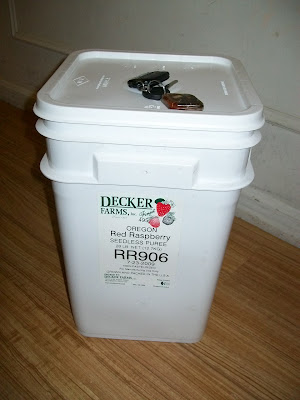
The humble plastic pail with my keys on top

I picked up some barrels from Nova Barrel. Today I wanted to show you what Im doing with these nifty square 4.5-gallon pails. Next week Ill show you the compost barrel, the black soldier fly harvester, and the potato barrels...

Ive played around with deep water culture, sometimes called "floating raft." But you dont have to have a floating raft. You just need to be able to keep the plants roots in the "nutrient solution."

For now lets hit the trust button that I know how to plumb this into my system. I find Im better at showing than telling, so let me show you what Ive done so far.

Pail with holes and net pots

I pulled out my 2-1/4 inch hole saw (the same one you use to cut holes in doors for doorknobs). Turns out this is the perfect size for one of the standard sizes of net pots. I drilled four holes in the corners of the pail lid. Ive already wedged the net pots into the holes in the picture above.

I also drilled small holes in the center of the pail lid. These will allow water to drip into the pails. Below is a picture of the pail with a 3 foot vertical grow tower resting in the center.

Grow tower supported by the pail

Ill be plumbing these into my system sometime in the next week. Ill fill the net pots and tower pockets with hydroton, then planting can begin.

You could do this with regular round 5-gallon pails. There are lots of pail-based deep water culture systems out there, though I dont think Ive seen any connected to an aquaponics system. I like the square pails because they have a flat side that will work well with the home-made grey plastic bulkhead fitting I use for the rest of my through-wall plumbing.

Heres a sketch showing how Ill achieve constant height of water in my pails (think Durso Siphon or Standpipe). A crate structure will support the flat sides of the pails and block some of the light that will otherwise get to the roots. Ill anchor an EMT loop in the crate structure to hold the grow towers upright and support the piping for the water coming in from the sump.

Sketch of aquaponic vertical tower/deep water culture concept
Read More..

crystal clear water

Because of the crystal-clear water, Flathead Lake in Montana seems shallow, but in reality is 370 feet in depth.


Turquoise Pool, Chile
 
Read More..

Aeration And Water Movement

 
These plants thrive right above the air stone!  (LINK)
Could this be caused by the movement of water through the roots or is it increased oxygen?  In any case, whether its due to increased oxygen or water movement it is obvious that air stones in the raft tank are quite beneficial.

I asked Forest, my friend and hydroponic guru, if it might be due to water movement.  He felt strongly that its the improved oxygen in the water rather than water movement.  Im still on the fence about that, but Forest really knows about hydroponics so I tend to believe what he says.

But this has gotten me thinking  about adding an aquarium PowerHead and/or incorporating an Under-Gravel Jet System as described at this link.  The Under Gravel Jet appears to be very similar to a Fluidized Sand Filter.  
I found this article about designing a Fluidized Sand Filter.  
Further research shows that they can be designed to remove Nitrates as well as Ammonia and Nitrites.  This of course is not what we would desire in an aquaponic system, but it appears easy enough to avoid removal of Nitrates by not building the filter too deep.


Devin uses very large 12" air stones in his raft tanks under the gravel.  Yes he places gravel in the bottom of his Floating Raft tanks.   His results are astounding and I tend to agree with Devin about Rafts vs Gravel beds.   Transplants do better when placed into a raft and growth rates seem to be better, and with good aeration the raft systems can only be improved.

I bought a Hydrofarm Active Air Pump.  
Its a bit noisy but an optional volume control can turn adjust the volume and the noise.

* UPDATE October 10, 2012 -  This Hydrofarm pump has been running 24/7 for 4-1/2 months.  It progressively became louder until it sounded like a jack hammer.  Two days ago I turned it off and replaced it with a new EcoPlus Commercial Air 5.   Even after rebuilding it with parts supplied by the distributor it was no longer working properly.    I have high hopes for the new EcoPlus Commercial Air 5.  It runs much cooler than the Hydrofarm pump which ran so hot I could not even touch .
The new EcoPlus Commercial Air 5. is by no means silent, but it purrs with a low tone rather than a raspy and unpleasant noise. 
The noise was too much so I placed the air pump inside my shop and plumbed the line out to the system
Heres a video about how to repair an air pump


Today I placed four fat air stones in this raft tank under about 4 inches of gravel.
 
Its about time to make some better rafts 8-)

Read More..

Fresh Water Monsters

River Monsters with Jeremy Wade

A friend insisted I sit down and watch a few episodes of River Monsters, one of her favorite shows.

Wow. Seriously fun show.

In the mean time, my little monsters appear to have given up their piscivore habit - no new victims despite the fact I was on travel last night and my delegated fish-feeders forgot. [Late or missed feedings in past have resulted in floating victims...]

Meanwhile the little bugs are gone. I sprayed them off physically with water, then applied an organic pest control for caterpillars and bugs made from common kitchen staples (check out Organic Garden Pest Control).

You know, a reason I have time to watch River Monsters and blog is my fish and garden take practically no time to maintain. Toss some food to the hungry fish, glance around the garden, ooh and aah at how much everything has grown. Thats it.
Read More..

Weeding

Ray has documented an experiment where he weeded one section of his garden and let the other go natural.  So what do you think?  Is weeding just for show or does it help your plants grow better?

This link will start his video at the point where he shows his experiment.
http://youtu.be/Zl_zxmqQ1EU?t=8m48s

Or you can watch the entire video about compost tea nutrient extraction which is different from brewing compost tea for microorganisms. 


Read More..

Is Water Flushed From A Filter Better

Ive often heard people say water flushed from a filter is better for your plants. 
I wondered how true that is.  Is It higher in Nitrate?
Heres the test.
Its higher in some trace elements, but dont count on it for Nitrate.

The problem with dumping this on your terra-garden  is that this nutrients are lost from the aquaponic system.
Read More..

Microbes

Nematode

Mycillium attached to nematode.


Read More..

Water Storage and the BioSand Filter


825 gallon rain water catchment system

I live in the US, in arguably the richest county in the US, per capita (Fairfax, VA).

Even so, there are times when no amount of money can make potable water come out of my tap. System flaws (e.g., water main ruptures), acts of God (e.g., hurricanes), or acts of man (e.g., sabotage) can all mess with the availability and/or quality of my water.

Not cool. Thirst, dysentery, and cholera are nasty things.

Im loving the magnitude of water storage possible with common 55-gallon drums and PVC pipe or hose and hose fittings.

But if I had an infinite supply of water, Id still have to purify it.

I have my solar oven, with a water pasteruization indicator (WAPI), a little vial filled with soy wax. You put it in a container of water with the wax side up - come back after a day in the sun, and if the wax has melted and re-coalesced at the bottom, you know the water was at 200 degrees Fahrenheit for at least 10 minutes and has been pasteurized.

But I think Ive come across something even better: The BioSand Filter. One of these babies can produce 5-15 gallons of clean water in an hour. Here are two videos: a funny one that doesnt really explain the physics/biology of the thing, and an earnest Christian charity one that does a great job of explaining all the details you need to understand:

BioSand Filter - Cute video (light on detail)


BioSand Filter - Earnest Christian video

Wikipedia has a nice article on the BioFilter, and theres a website called BioSandFilter.org that gives details regarding who, how, and what, for those of you who like those kinds of details.

Enjoy!

Read More..

Making and Installing Ollas in the Garden an Ancient Watering System


Saving water with ollas is a great idea.  This series of videos from High Desert Garden shows how to do it easily and inexpensively.     High Desert Garden also created a video showing how to make your own ollas from clay, but using terracotta pots is less expensive, faster and easier.

Ollas will buffer the water needs of a garden, but realistically they are not large enough to get you through the day, so High Desert Garden uses an ingenious method of feeding the closed ollas from a larger reservoir.

Read More..

Ten Calories Of Energy To Produce One Calorie Of Food

I just read the article  "The Permaculture Solution – an Interview with Warren Brush". It said "Estimates are that the modern agriculture system uses ten calories of energy to produce one calorie of food."

Fearing that I too may be growing negative net energy food. I immediately looked at the energy costs involved with my soil-less gardens. My hydroponic pump uses 160 watts-hours per day or 137.6 KCal or about 576 KJ/day.   Chris Carr was kind enough to remind me that nutritional calories (KCal) are equal to 1000 chemistry calories (cal).    A chemist would probably use Joules and Kilo-Joules (KJ) rather than KCal.   But the we think of food in terms of KCalories rather than Joules, so Ill keep it in KCal also known as large calories as much as I can.  There were other errors in my first draft,  so heres the rewrite.  Many of my calculations will be done using the Energy and Work Unit Conversion at unit-conversion.info/energy.html. 

I did some research and found a daily harvest of 8lbs of lettuce and 100lbs of tomatoes to be respectable averages for a 100sf garden. So I will be using those figures throughout.
Just for grins lets say you irrigate 100 square feet of garden with 10 gallons per day, and you are pumping water from lets say 100 feet below the surface. 

To calculate the power used to pump 10 gallons per minute 100

Pwhp = q h sg / 3960
where
Pwhp = water horsepower (hp)
q = flow (gal/min)
    = (10)
h = head (ft)
              = (100)
sg = specific gravity = (1)
Pwhp = 10x100/3960 = .2525whp = 0.04497210699688 KCal/sec
This could also be expressed as 188.2892175745  J/sec which is the definition of a Watt.

If you are following along and checking my math you can use the Power Unit Conversion to find the Power.
Power and Energy are different.  Energy is what is delivered and Power is the rate at which it is delivered.
In the above example we deliver 188 Watts for 10 minutes or 31.38 Watt-Hours


We pump for 10 minute so
0.04497210699688 KCal/s  x  600sec = 26.9 KCal
So how many lbs of vegetables would you need to produce 26.9 KCal
Lettuce
is
67.37 KCal per lb so you would need 26.9/67.37 = 0.40 lbs of lettuce per day from your 100 sq ft garden. If you harvest 8lbs / day the net gain is 19.97 times
T
omato is 80 KCal per lb so you would need 26.9/80 = 0.34 lbs of tomatoes per day from your 100 sq ft garden  If you harvest 100lbs / day the net gain is 296 times

Below is a list of common vegetables which I got from http://www.freedieting.com/tools/calories_in_vegetables.htm


Lets put this in perspective of a soil-less aquaponic or hydroponic system:
Lets say you use a 20 watt pump 5 hours a day.
    Thats 20 watt-hours x 5 hours/day = 100 Watt-Hours / day  (
W-Hr/day)
    Each W-Hr is equal to 0.859845227859  KCal so you spend about 86.0 KCal to pump water each day.

If you grow 8 lbs of lettuce per day on your 100 sq ft aquaponics garden,
8lb/day x 67368 cal/lb = 538944 cal/day or  ,  538.944Kcal/day

You would spend 86.0 KCal to pump water to produce 538.944 KCal of lettuce.
A return of over 6.27 to 1.  Not quite 19.97 times like soil gardening but pretty good!


How about tomatoes...
Lets say you grow 100 lbs of tomatoes per day in your 100 sq ft garden.   
Let also say you use the same amount of electricity - (86.0 KCal/day).
100 lb/day x 80 KCal/lb = 8000 calories/day
So you would spend 86.0 KCal/day to produce 8000 KCal of tomatoes.
A return of over 92 to 1.  Soil gardening was 296 but this is not bad!

Compared to soil gardening the power efficiency is not as good, but water is also a commodity worth preserving and my guess is any of the soil-less methods will beat soil based gardening several times over.   It gets pretty complicated if you consider that some of the water applied to soil returns to the aquifer but ponics are definitely more efficient with water.  

Back to my hydroponic system which consumes 137.6 KCal per day.  It would need to produce 1.72 lbs of tomatoes per day.  But this is just the power used to move water.  Warren Brush was including the power used to make fertilizers, mine, and apply nutrients, and maintain the crop from start to finish.  Thats beyond the data available to me, but at least it still looks like a positive net gain whether you are gardening with soil or without and probably far better than the modern agriculture system using ten calories of energy to produce one calorie of food.

Aquaponics has a side benefit of fish protein which I have not included, but the energy used to make fish food should be considered.  Bioponics on the other hand is free of any further input save iron and magnesium which is also required in aquaponics.


Ill admit this article was difficult for me,  I feel like I have dyslexia where it comes to keeping units straight.  If you find any errors I will correct them, but to my best knowledge I have presented this correctly.
Read More..

Water Storage

As water becomes more difficult to obtain we are going to be forced into looking for better solutions.
This is a section of a modular water wall.
I did a quick search and others are also thinking along these lines and some of the walls are very decorative.  The idea of free or cheap drums is admirable but they are not large enough nor are they aesthetic.
 
Its time to think outside the box.  What about large reservoirs of water under our houses or hidden within our walls which would also be used to moderate temperature with its thermo-mass.

I used to live in a very old house in downtown Tucson.  The walls were built of adobe and they were nearly 3 feet thick.  The hot Tucson summers were quite bearable due to the thermo-mass of these walls even though I had no air conditioning.


If we were to build houses like this our energy and water consumption would both drop.  A stucco finish would make the walls look like any other house except for thick walls, and the comfort would be amazing.  This water could be collected during the rainy season and used later in the hot dry summer months to grow food and ensure a beautiful cooling landscape.
.
A family of five uses  about 1 acre foot (about 325,000 gallons) or (1225 m3) of water a year.  So saving water from your roof top may only make a small difference, but small differences add up.   Right now it costs about $1000 to process that much water from waste water or to build a new reservoir.  

Desalination has been done in other parts of the world and California is going to build a desalination plant in San Diego capable of 50 million gallons (189000 m3) a day.  But the cost is probably going to be twice the cost we are used to.  There are also concerns that the plant will kill fish, but efforts are being incorporated that should solve this problem.

In total fifteen desalination projects using reverse osmosis are proposed along the coast from Los Angeles to San Francisco Bay.  In the past many other desalination plants have been closed due to the high cost of operation.  The plant will use an enormous amount of energy -- about 38 megawatts, enough to power 28,500 homes.  
The efficiency works out to be about 3 kWh for 1 m3or 88 gallons / kWh fresh water.  Sounds like a lot of water, but the reality is this will only provide about 7 percent of the total water needs of San Diego County.   

Another problem I see is that this is going to be privately owned.  I would prefer to see communities own their own water source.


Read More..

Water Facts

From Ensia.com
http://ensia.com/infographics/are-we-on-the-path-to-peak-water/

 For more:
http://www.waterfootprint.org/
Read More..

Water cooler style auto top up

Heres a couple of short videos showing my water cooler-style auto top up


Bottle Empty


Inserting Full Bottle


I didnt think to pull out the base to show you, but it is just one of the bottles I used to use for my window farm. I cut off the top of a standard 5-gallon water bottle (I drilled a 1-inch hole near the top, then used tin snips, finishing the edge with some 1/4-inch tubing sliced so it could fit over the raw edge of the plastic). Since I need water to flow in and out of the base, I drilled additional 1-inch holes near the bottom. If you drill too fast, the plastic can rip (why would I know this...).

Heres a picture showing what the 5-gallon bottle looks like with the lid snipped off (I originally did this to create a fish tank for my aquaponics window farm system):

Read More..

Water is flowing in the IBC system Cycling and Phoshate


Close to completion. The outdoor IBC system is flowing water. Take a look at my settling tank. Its based on a wet dry filter. The cool part is if it gets clogged it will not jam up the system.

Ive begun to fill the beds with plants, but have no fish.  Im cycling the system, but right now I want root growth.  So I embarked on a study of Phosphate.  

Here are two articles I believe are quite good although somewhat over whelming.
  • Phosphate and the Reef Aquarium
  • Aquarium Chemistry: Phosphate and Math
Read More..

Summer is the Time to Plant Winter Squash!

Winter squash takes about three months to mature.  For a September harvest its time to plant!

Remember squash are heavy feeders so add plenty of compost below and around each plant
Time to choose your brassicas for late summer planting. 
Read More..

Alternative Water Pumps


The Spiral Pump aka Wirtz Pump might be an alternative for those looking to pump water using wind, solar or water flow from a stream.

The Spiral Pump requires very little energy, and can utilize various methods of mechanical energy
The pump takes advantage of the entrapped air to achieve remarkable head pressure.
Unlike a Ram Pump, this pump is quiet and very simple.

Another pump worth looking at is the Geyser Pump. aka Airlift Pump

Calculations for Airlift Pumps can be found starting on page 50 of this PDF from Kieth Tatjana

A simple spreadsheet for Airlift Pumps


This is my quick Geyser Pump

Several days later I added a check valve as seen in the videos below.  I pumped 4 lpm of air into the airlift pump and got almost as much water back out in return!   70 lpm in may not deliver the same results, but I will post the results when and if I get around to making that test.


Heres another method - the Airlift Pump


Another look at the Glenn Martinez Airlift Pumps


AquaLab: Ex 06 Airlift pump experiment demo

Skip Kemp has more aquaculture videos that you may find interesting


But this may be my favorite! 


Real Pit Bull Demo


This Wiki Link shows many types of pumps.
I am a little disappointed they did not include the Tesla Turbine


Read More..

Water Rules for Chico CA

Lawn watering restricted to three days a week.
Odd numbered addresses: Sunday, Wednesday and Friday.
Even numbered addresses, Tuesday, Thursday and Saturday.
No lawn watering on Monday
• No watering from 8 a.m. to 6 p.m., except by drip irrigation, microsprayers or by hand.
• New homes need to have drip irrigation for landscaping.
•Water should not flow to non-irrigated surfaces, like sidewalks or into the gutter.
• When watering, water should not run off the landscaping.
• When washing cars, the hose needs to have a shut-off nozzle.
• Water features such as fountains need to recirculate.
• No watering outdoors within 48 hours of a measurable amount of rain.
• No watering or refilling ornamental lakes or ponds except to sustain existing aquatic life.

For the past few years I have been actively experimenting with many water conservative method of gardening.  I have built experimental gardens which I enjoy sharing with others. 

If you are interested seeing a variety of water saving ideas, and wish to visit my gardens send me a message on Facebook - bob.campbell.chico

Some of my gardens can be scaled up to commercial size while others are appropriate for apartment balconies.


Read More..

Water Wise Garden

This is basically the same Earthan Beds Ive been building, but its done in the ground.
Here are some pictures of how I built this water wise garden.
The hole was dug with a trench for the 4" drain line and a sump pit at the lowest point

The pond liner placed with 4" perforated drain line.  Notice the filter sleeve on the drain line.

Gravel being spread level
  Here the water is used to help me spread the gravel level across the entire bed.  I find it useful to temporarily raise the water level to the top of the gravel for this procedure.  When finished the water level will be maintained 2" below this level so that the soil does not sit directly in the water.
This black shade cloth is laid on top of the gravel to keep the soil from washing down into the gravel
The water tank has not been installed yet.  I will bury it next to this garden bed and pull the pond liner down so that it drains excess water into the tank. 
The soil has been added.  This soil mix contains has enough clay that it will wick the moisture up from below
I will clean up the edge so that it looks nice.  The pump sits inside the 6" PVC pipe.  I used 1/2" PVC pipe to connect the tube that runs to the other end through the 4" drain line.  I will also extend electricity to the side of the garden so that I dont have to use this extension cord.

A thick layer of mulch will be added when I plant.  This garden will save rain water, and maintain moisture below the surface without loss to evaporation.   There is no need to water this garden other than occasionally maintaining some water in the reservoir tank.  The amount of water used will depend upon the type of crop and the heat, but it will not waste a drop.

After I install the large reservoir water tank the pump will be moved out of the sump to the larger tank.  It would have been easier to have done it this way from the beginning, but I did not feel that I was up to digging a hole that size right now, and wanted to get this garden planted.   Here is a diagram of how it will eventually work.

This could be duplicated on a much larger scale for commercial farming. Sure its a lot of work and extra expense, but the savings in water should count for something. With a large enough reservoir, and contouring of the land; the need for any extra water could be eliminated by capturing rain water..
 This is July 4th.  The basil and tomatoes have done well.  Its been about 10 weeks since this garden was planted and it has used about 100 gallons of water from the reservoir which provides flowing water under the garden bed 24/7.   Its been the easiest of all my gardens because I have not had to water it.  The tank pictured below holds 135 gallons.  There is a small Model 5 utility pump inside that pumps water to the far end of the rocks buried below the soil.
I plan to build a top for this so that it looks nice.  I would not want someone to trip into the hole. I also need to finish running an electric outlet over to the pump.


Read More..